CloudChef SmartCMP Platform: a "Platform of Platforms" to Connect Everything
Within large organizations and digital enterprises, IT architectures are becoming increasingly complex:
The coexistence of public clouds, private clouds, and on-premise data centers, hybrid general and intelligent computing, coupled with various operations, security, and service management tools, leads to an IT landscape characterized by "functional silos, data fragmentation, and broken processes". Enterprises commonly face the following challenges in governance and operations:
1. System Fragmentation and Severe Management Silos
Systems like ITSM, CMDB, IPAM, PAM, backup, security scanning, and bastion hosts each have their own functions, processes, and account systems.
Users need to switch between multiple systems, submit requests multiple times, and repeatedly fill in information.
Management personnel cannot obtain a global view from a single system and must manually integrate data from multiple sources.
2. Lack of Unified Processes, Heavy Reliance on Manual Operations
Operations like cloud resource provisioning, permission configuration, backup policy setup, and compliance checks require manual coordination across multiple platforms.
Systems lack standardized process integration. Approval flows, execution flows, and callback mechanisms all require manual maintenance.
Processes cannot be encapsulated into a unified platform, making standards difficult to enforce and steps hard to track.
3. Data Inconsistency and Inaccurate Asset State
Asset information in the CMDB often becomes "stale" due to a lack of automatic synchronization.
IP states in IPAM do not match actual usage, leading to address conflicts.
Security platforms are disconnected from actual resources, causing scan scope omissions or duplicates, and preventing the establishment of resource-risk mapping.
4. Compliance Controls Rely on Documentation and Manual Agreements
Operations like security scanning, baseline hardening, backup policies, and account permissions rely on subsequent remediation or the conscientiousness of responsible personnel.
The lack of automatic enforcement mechanisms reduces compliance to a formality, making it difficult to prevent risks proactively.
5. Uncontrolled and Untraceable Operations
Systems are dispersed, logs are scattered, and critical operations are difficult to audit.
Administrators cannot uniformly view who created which resources, when, whether security mechanisms were enabled, or if data was entered into the CMDB.
Incident response chains break down, making troubleshooting difficult and causing delayed responses.
6. Difficulty Integrating New Systems, High Expansion Costs
Integrating a new security system, audit platform, or toolchain requires separate interface development and integration process design.
API, permission models, and data structures differ across systems, lacking a unified abstraction.
Each system integration is like "building a new road from scratch"—costly, time-consuming, and with uncertain outcomes.
As internal informatization and digitalization within enterprises continuously improve, traditional management models often lead to fragmented processes, numerous management blind spots, and difficult data integration. Enterprises urgently need an "upper-layer governance platform" to connect and unify the data, processes, and capabilities between these heterogeneous platforms, enabling comprehensive coordination and rapid resource delivery. This is precisely the value of the "Platform of Platforms.
The "Platform of Platforms" is not a simple integration tool but a unified middleware platform for governance, orchestration, automation, and compliance:
It connects underlying platforms such as ITSM, CMDB, monitoring, PAM, backup, and DevOps.
It provides standardized data models and component encapsulation, enabling different systems to have a unified semantic expression.
It organically combines multi-platform capabilities through a visual workflow engine to achieve business process automation and governance closure.
As the single trusted operational interface, it provides end-to-end visibility, control, and audit capabilities.
CloudChef SmartCMP is precisely such a Platform of Platforms. Based on an open architecture and component model, it builds unified capabilities for resource management, process-driven operations, security compliance, and multi-system orchestration, fully supporting enterprises in constructing an intelligent, automated, and well-governed IT operations system.
1.Model-Driven: Building a Unified Language for Resources
Based on the TOSCA standard, it enables cross-cloud, cross-system resource modeling.
Abstracts resources into "components": including cloud resources, application software, automation tools, external systems (e.g., backup, ITSM, PAM), etc.
Supports encapsulating properties, lifecycle, dependencies, and operational interfaces for full lifecycle management.
This mechanism breaks the constraints of traditional architectures centered around a single system, provides a unified resource description foundation for upper-layer platforms, and enables various systems to be orchestratable and composable.
2.Plugin Mechanism: System Componentization and Process Automation
Any IT system with an API can be encapsulated as a component plugin.
Supports scripting forms like Python, Shell, Ansible, Terraform, etc.
Plugins can be embedded into any step of a process, supporting control points like pre-checks, conditional execution, and failure handling.
Through the plugin mechanism, CloudChef SmartCMP encapsulates the operational capabilities of underlying platforms into reusable modules, facilitating unified invocation and orchestration, and ensuring the platform can quickly adapt to an expanding ecosystem of heterogeneous systems.
3. Customizable Process Engine: Execution Means Compliance, Process Means Control
Integrates resource delivery processes with systems for approvals, backup, security, PAM, CMDB, and IPAM.
Every resource creation process can embed multiple system calls, achieving "compliant-upon-delivery and audited-upon-change."
Supports multi-tenant, multi-level role-based process control and dynamic approvals, adapting to complex organizational structures and governance requirements.
This process engine not only automates operations but also carries the unified expression of governance logic, serving as the core foundation for the Platform of Platforms' "governance-driven delivery."
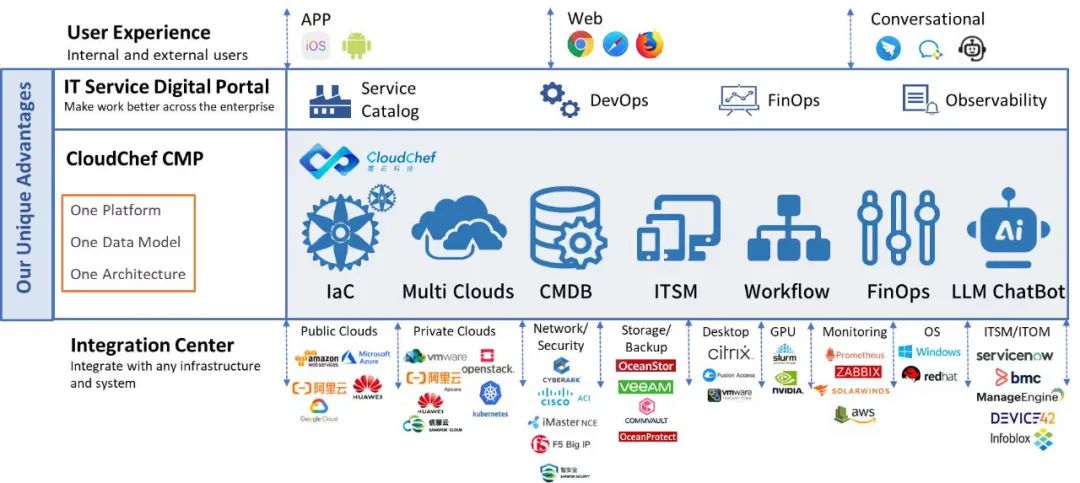
(Architecture Diagram of the CloudChef Platform)
As a Platform of Platforms, the core foundation of CloudChef SmartCMP's integration hub lies in a unified data model, adopting the international standard OASIS TOSCA (Topology and Orchestration Specification for Cloud Applications). Based on TOSCA, we construct a unified resource and system integration model, forming a composable, governable, and orchestratable expression for cloud resources and various systems.
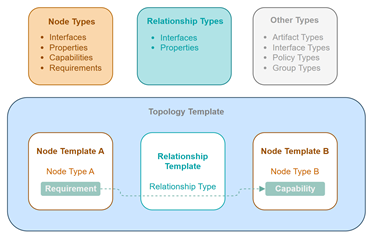
(TOSCA Model Core)
CloudChef SmartCMP extends the TOSCA model, broadening the scope of modeling from cloud resources to various ITSM, backup, security, and operations systems, resulting in the following functionalities:
Abstractly describes all system entities, including virtual machines, networks, storage, middleware, databases, account systems, backup systems, bastion hosts, PAM, tickets, approvals, security platforms, etc.
Standardizes the encapsulation of resource capabilities (e.g., "create snapshot”, "initiate scan”, "allocate IP”, "request credentials") and operational capabilities of third-party platforms (e.g., "initiate vulnerability scan”, "sync to CMDB”, "call bastion host authorization”, "push alert information") as node operations for invocation by the process engine.
Supports model-driven definition of parameters, lifecycle hooks, and automation tasks during service catalog configuration, forming a highly consistent service definition language.
Through the OASIS TOSCA model, the CloudChef platform not only supports resource orchestration but also becomes a structured expression language for cross-system platformlinkage,endowing CloudChef SmartCMP with the platform architecture characteristic of "components as system capabilities, models as governance rules”, laying the foundation for subsequent capabilities like process automation, security linkage, and service abstraction.
Having interaction capabilities with various systems is necessary, but it's also crucial to string various operations together to achieve a standardized, automated, and controllable process. CloudChef SmartCMP's workflow engine is not only used for resource delivery and approval control but also serves as the unified carrier for all cross-system governance actions.
Traditional compliance management often relies on documentation, post-facto audits, and personnel conscientiousness. The biggest problem is that "compliance does not equal execution”, leaving significant gray areas in policy implementation. In multi-system, cross-departmental environments, omissions in any link can lead to serious security or governance risks.
CloudChef SmartCMP uses its orchestratable process engine to embed the organization's existing security policies, approval systems, audit requirements, and configuration standards into the automated processes of resource delivery and change. This makes compliance no longer reliant on after-the-fact checks but part of the process itself from the initial design stage.
The process is not just a carrier for automated execution but also a channel for policy implementation, visible control, and responsibility closure. Below are typical process integration scenarios:
1. Integrating Backup Systems
During the resource request process, users can self-select different levels of backup policies, or the platform can automatically match a default backup solution based on pre-configured service types and tags.
When creating resources, the process automatically includes the resource in the selected or policy-driven backup task via API.
Backup tasks are automatically deregistered when resources are released.
Allows business users to initiate backup-related change operations from the service catalog or resource detail page, including changing backup policies, performing ad-hoc backups, restoring historical data, etc., with full process automation and audit logging.
Ensures all critical resources are protected immediately upon deployment, continuously meeting data security and business continuity requirements.
2. Integrating Security Systems
During the resource request phase, the system automatically determines if the resource needs security protection based on its type, automatically assigns vulnerability scanning policies, configures baseline check tasks, and records the initial security state.
During the delivery process, it automatically calls integrated vulnerability scanning platforms and security baseline tools to perform security checks before new resources go live.
Visually presents the current resource's security status, scan results, and remediation suggestions, and supports linking with the service catalog to display this information in approval processes, enhancing approval transparency and risk identification capabilities.
During the operations phase, supports business users initiating on-demand scans or re-baselining from the resource detail page; results are automatically incorporated into the resource status.
Transforms security checks from "remediation" to "executed by default", achieving built-in security assurance within the process.
3. Integrating PAM and Bastion Host Systems
Newly created machines, databases, and other resources can be automatically registered with PAM and bastion host systems through the process, establishing account-asset mapping relationships.
Resources can be automatically categorized into PAM policy groups based on type, tenant, or tags, unifying account permission policies.
Supports bastion host access control, command recording, session recording, and other security audit functions.
Administrators no longer handle plaintext passwords; the entire process is automated and auditable.
4. Integrating IPAM and CMDB
During the resource request phase, the platform automatically requests IP addresses from the IPAM system, allocates subnets, generates required DNS records, and incorporates the initial configuration data as metadata into the resource management system.
During resource delivery, the allocated IP information is automatically written into relevant configuration files, ensuring consistency between the cloud platform and IPAM data.
During operations, when resources change (e.g., migration, replacement, release), the platform automatically synchronizes and updates IP status and cleans up invalid records, preventing IP conflicts or lingering allocations.
Simultaneously, the platform interacts with the CMDB during resource request, deployment, and change phases, automatically creating or updating CIs (Configuration Items), recording resource status, change history, and ownership, ensuring configuration data matches the actual state.
All integration operations are visually presented on the resource detail page, supporting audit and traceback, enhancing configuration visibility and data credibility.
The various resource capabilities, security, and backup capabilities of enterprise IT need to be provided more quickly to various teams. The service catalog encapsulates the integration logic of multiple systems, allowing business users to complete cross-system process operations simply by engaging with service items, avoiding direct contact with complex IT platforms. This achieves governance granularity "by service”, which is the user-side embodiment of the Platform of Platforms concept.
As the Platform of Platforms, CloudChef SmartCMP's unified service catalog is the entry point for user self-service and the core triggering surface that carries enterprise cross-platform processes and standardized governance policies. CloudChef SmartCMP presents various services—like cloud resource requests, permission activation, backup policy selection, and operations ticket submission—in a standardized way through the service catalog, stringing together the capabilities of systems like ITSM, CMDB, PAM, IPAM, backup, and security, achieving seamless connection between business users and IT operations/governance systems.

(Example Service Execution Flow for VM Request)
As a Platform of Platforms, CloudChef SmartCMP does not merely optimize a single local link. Instead, through the abstraction and unification of the entire IT operations and management chain, it comprehensively enhances the enterprise's operational capabilities and efficiency levels at the architectural, process, and governance layers. The benefits it brings can be quantified specifically in terms of resource efficiency, operational capability, data accuracy, security compliance, user experience, and more, as detailed below:
Dimension | Improvement Brought by SmartCMP |
Resource Delivery Efficiency | Improved 10x, reduced from 3 days to 30 minutes, especially significant acceleration in multi-system concurrent request and approval scenarios |
Operations Automation Rate | Supports complex workflows automatically triggering multi-system operations, reducing ticket intervention by over 90% |
Data Accuracy | Real-time synchronization with IPAM, CMDB, monitoring, etc., avoids asset "discrepancy between virtual and real |
Security & Compliance | 100% policy implementation, integrates compliance mechanisms like security scanning, backup registration, PAM access control within processes |
Resource Visibility | Centralized unified view of all cloud resources, platform calls, and system status for one-stop supervision and analysis |
User Satisfaction | Clear service catalog, supports configurable options, real-time approval progress tracking, significantly reduces business wait times |
CloudChef SmartCMP is the unified middleware platform and Platform of Platforms for enterprise digital governance. It connects processes, resources, tools, and people, systematically integrates various IT systems, eliminates data silos, and deeply embeds security, compliance, and efficiency into every delivery and operations action.
As the "Platform of Platforms”, CloudChef SmartCMP stands above various IT systems, using unified models, unified processes, and a unified perspective to transform traditionally dispersed toolchains into a collaborative, closed-loop governance hub. It not only breaks down the data barriers and execution links between different platforms but also provides business departments with an actionable, perceivable, and auditable digital service experience, helping enterprise IT move towards true intelligent operations and modernized governance.