Hybrid Cloud Management Solutions
Provide enterprise customers with solutions that seamlessly integrate multiple clouds to achieve stable, agile, highly scalable, secure, and low-cost services.
Challenge of Hybrid Cloud
Large technical span across multiple platforms of public cloud and private cloud makes it difficult for non-technical personnel to be familiar with the use of various platforms.
The cost and characteristics of the cloud environment need to be considered when placing hybrid cloud resources. Manual delivery is difficult to comply with standard specifications.
Low degree of automation, frequent manual operation. Difficult operation, long cycle of multi-cloud resource request, expansion, upgrade and update.
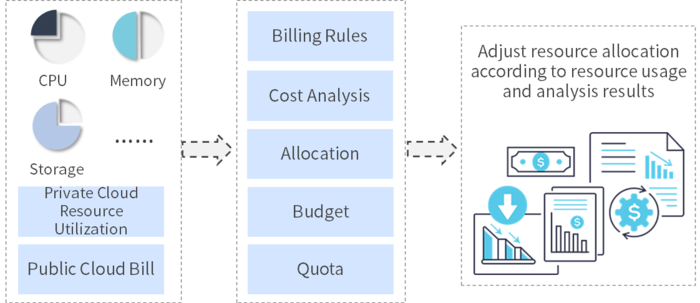
There is no standard billing for private clouds; at the same time, it is difficult to count public cloud bills, resulting in lacking an overall perspective, and unable to unify cost analysis.
Unified infrastructure management and operation to comprehensively improve the enterprise IT governance capabilities in hybrid cloud scenarios
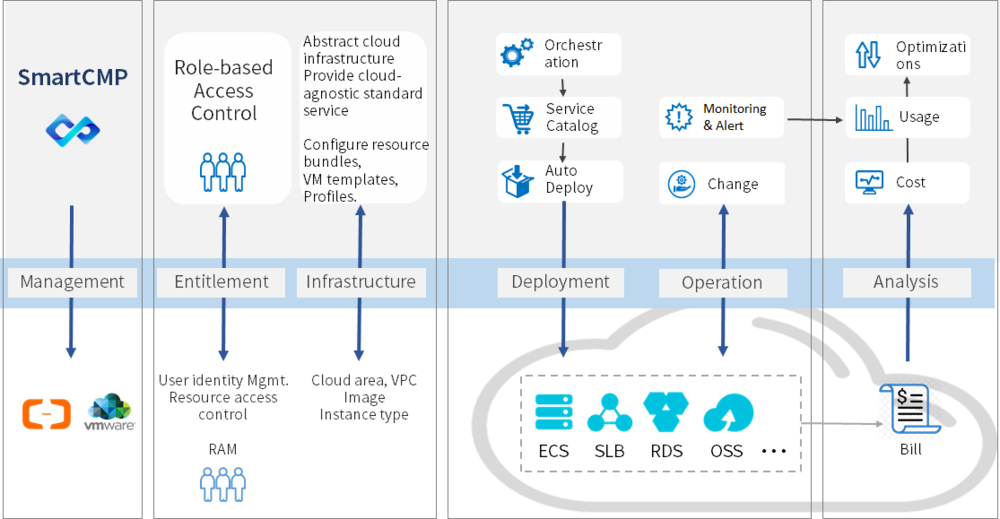
Heterogeneous but Unified Service
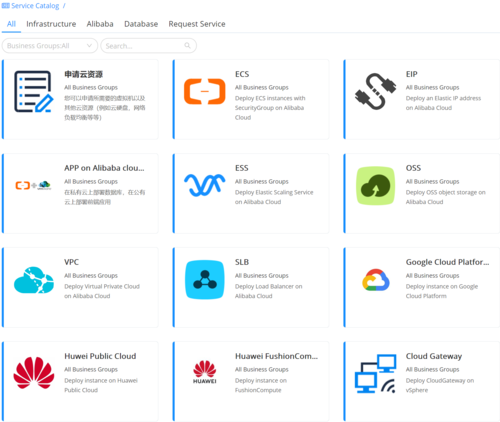
- Provide a unified cloud service portal for end users, servicing the request, operation, change, monitoring and recycling of cloud resources.
- Supporting enterprise-level process, entitlement, and quota control.
- Cloud-agnostic blueprint service. Users do not have to worry about the underlying supplier of resources.
- Users can apply for any cloud service from their own service, like public cloud service experience, standardized processes at no additional learning costs, greatly reducing the difficulty of use.
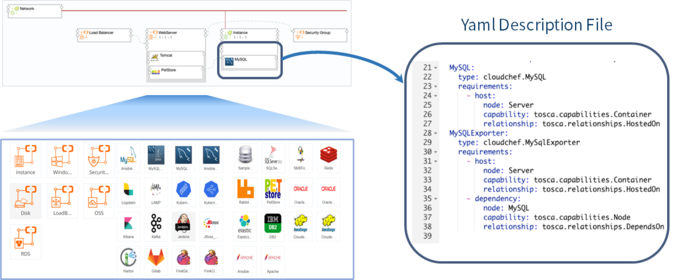
Application-oriented Service Orchestration
- Industry-leading blueprint orchestration function. Blueprint is an abstraction of applications, bringing the effect of infrastructure as code.
- The application architecture is built once, used repeatedly on demand, and automatically generated.
- Continuously deliver the deployment and upgrade of the overall application environment in different environments such as development, testing, and production to meet DevOps best practices.
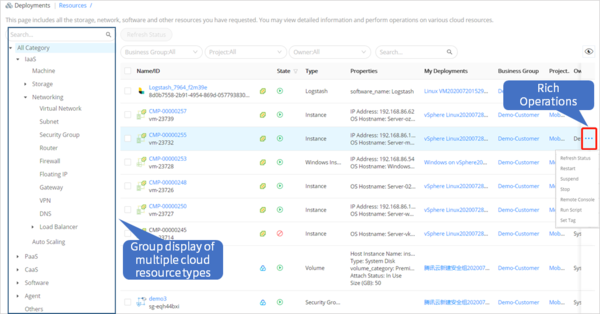
Comprehensive Monitoring & Alerts, Self-service Operation
- Strong self-service ability for operation changes.
- Display all cloud resources requested by users on a unified interface, allowing perform operation changes on various cloud resources by themselves.
- Visualization of deployment topology status, real-time understanding of application deployment progress, overall application environment’s configuration, resource performance, and abnormal issues.
- Abundant alert types and alert strategy settings are notified to relevant personnel in a variety of ways, so as to keep abreast of the operation of the hybrid cloud platform.
Usage Analysis, Clear Cost
- Unified resource management and control of the hybrid cloud environment by department or project, including resource quotas, workflows, resource lease periods, usage analysis, and optimization suggestions.
- Multi-dimensional cost analysis in graphical display, request trend analysis, public cloud bills allocation and private cloud billing rules to quickly gain insights into multi-cloud environment costs.
- Based on load and cost analysis, we can quickly find idle resources to adjust, release, and reduce excessive configuration with one click, and manage and optimize cloud assets.
More solutions
Rich solutions to meet your business needs